
Take 5 with Visiting Artist Yeonsoo Kim
July 28, 2026 by Katie Baum
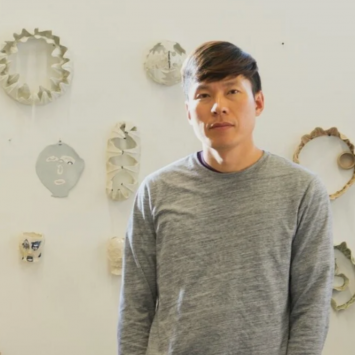
Yeonsoo Kim is a South Korean ceramic artist currently based in the United States. His work has received national and international recognition, including being named one of NCECA’s Emerging Artists of 2020. Most recently, he was honored with Best in Show at the 2025 Smithsonian Craft Show and was distinguished as the Featured Artist and Best in Show winner at Richmond Art and Design (2025). We "took five" with Kim in advance of his upcoming Visiting Artist Workshop to learn what Kim has to say about contemporary ceramic trends, his teaching philosophy and being a ceramic artist.
1. What excites you most about your current body of work?
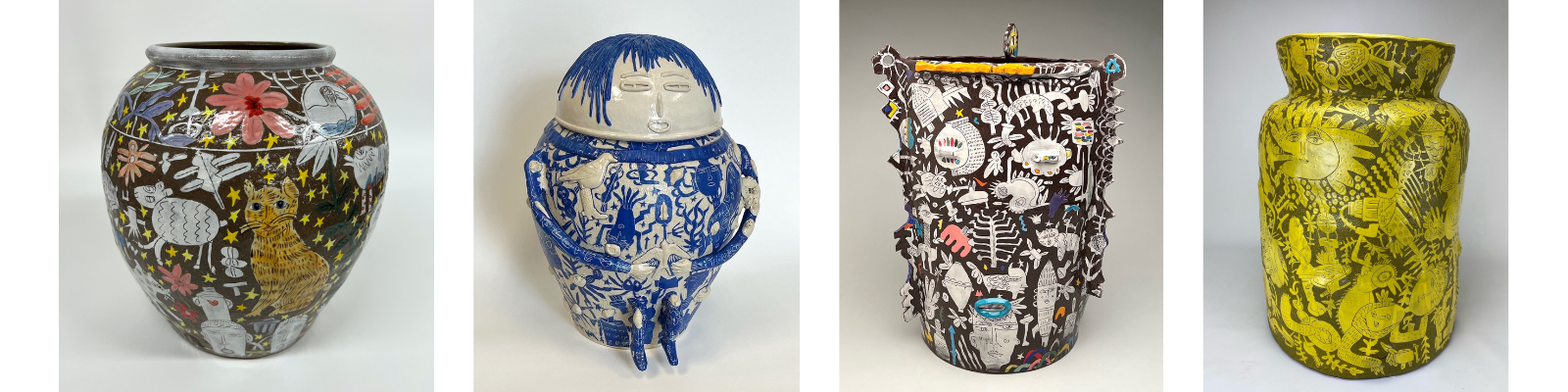
What excites me most right now is the dialogue between traditional form and contemporary narrative. I am working with dark, iron-rich stoneware bodies and traditional Korean Onggi coils, layering them with white slip and fine sgraffito and inlay drawings.
Taking ancient motifs—such as traditional vessel stands (gidae), tou figures, or guardian shapes—and bridging them with modern human emotions like diaspora, isolation, and quiet domestic relationships allows me to treat ceramics not just as vessels, but as dynamic sculptural canvases for story-telling.
2. Are there any artists or trends in contemporary ceramics that you particularly admire?
I deeply admire the growing trend in contemporary ceramics where the boundary between traditional craft and fine art sculpture has completely dissolved. Ceramic art is no longer confined to utility; it commands a powerful, conceptual presence in modern galleries and museum spaces.
I am particularly inspired by artists like Grayson Perry, Sunkoo Yuh, and Do Ho Suh. Grayson Perry’s brilliant use of narrative and drawing on ceramic surfaces, Sunkoo Yuh’s expressive and intricate figurative ceramic sculptures rooted in personal and cultural heritage, and Do Ho Suh’s profound exploration of space, memory, and diaspora all deeply resonate with me. Seeing how these artists transform personal histories and cultural identity into compelling contemporary expressions is a constant source of inspiration for my own practice.
3. What aspect of the ceramic process inspires you the most (materials, making, firing, etc.)? Has this changed over time, and if so, how?
Early in my career, I was captivated by the sheer thrill of making—mastering physical techniques and the unpredictable magic of the firing process. Over time, however, my primary source of inspiration has shifted toward my relationship with the material itself.
Clay is remarkably honest; it absorbs your breath, your pace, and your physical energy. Today, the rhythmic, slow process of hand-building coils and carving through slip feels almost like a meditative performance and an intimate conversation with the clay. Technique has become second nature, allowing the raw tactile experience to directly mirror my inner narrative.
4. What's your philosophy as a teacher of and ambassador for the ceramic art form?
My philosophy centers on passing down not just mechanical skill, but the cultural philosophy and patience embedded in the craft. When I teach traditional Korean Onggi methods or slab techniques, I encourage students to look beyond technique and ask: "How does this material carry my voice?" > As an ambassador for the medium, I want to show that tradition is not a static museum piece—it is a living language. True preservation happens when we take ancient roots and use them to express our contemporary lives.
5. What's something underrated about or a misconception you would like to dispel about being a working artist in ceramics?
There is a romanticized misconception that ceramic artists spend quiet, peaceful days calmly spinning a wheel with a warm cup of tea nearby! In reality, being a full-time ceramic sculptor is an extraordinarily demanding blend of intense physical labor, precise material science, and rigorous studio management.
Lifting heavy clay, navigating structural shrinkages, risking weeks of work in high-temperature firings, and managing the business behind an art practice require immense physical stamina and mental grit. Pottery isn't just a serene craft—it is a tough, deeply physical, and conceptually rigorous fine art form.
Kim will lead a Visiting Artist Workshop titled "Breathing Volume: Traditional Onggi and Buncheong Expression" on August 15 (demonstration only) & August 16 (hands-on workshop). Register here.